Description
Abstract.
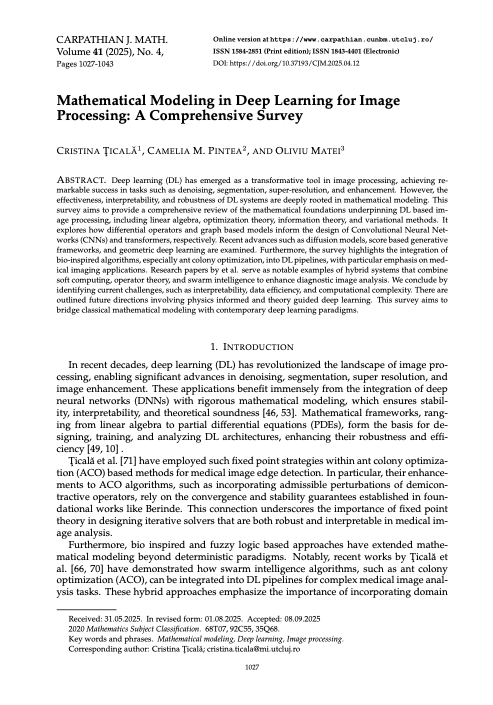
Deep learning (DL) has emerged as a transformative tool in image processing, achieving remarkable success in tasks such as denoising, segmentation, super-resolution, and enhancement. However, the effectiveness, interpretability, and robustness of DL systems are deeply rooted in mathematical modeling. This survey aims to provide a comprehensive review of the mathematical foundations underpinning DL based image processing, including linear algebra, optimization theory, information theory, and variational methods. It explores how differential operators and graph based models inform the design of Convolutional Neural Networks (CNNs) and transformers, respectively. Recent advances such as diffusion models, score based generative frameworks, and geometric deep learning are examined. Furthermore, the survey highlights the integration of bio-inspired algorithms, especially ant colony optimization, into DL pipelines, with particular emphasis on medical imaging applications. Research papers by et al. serve as notable examples of hybrid systems that combine soft computing, operator theory, and swarm intelligence to enhance diagnostic image analysis. We conclude by identifying current challenges, such as interpretability, data efficiency, and computational complexity. There are outlined future directions involving physics informed and theory guided deep learning. This survey aims to bridge classical mathematical modeling with contemporary deep learning paradigms.