Additional Information
| Author(s) | Lascsakova, Marcela, Penjak, Vladimir |
|---|

 carpathian_2004_20_067_072_abstractcarpathian_2004_20_067_072
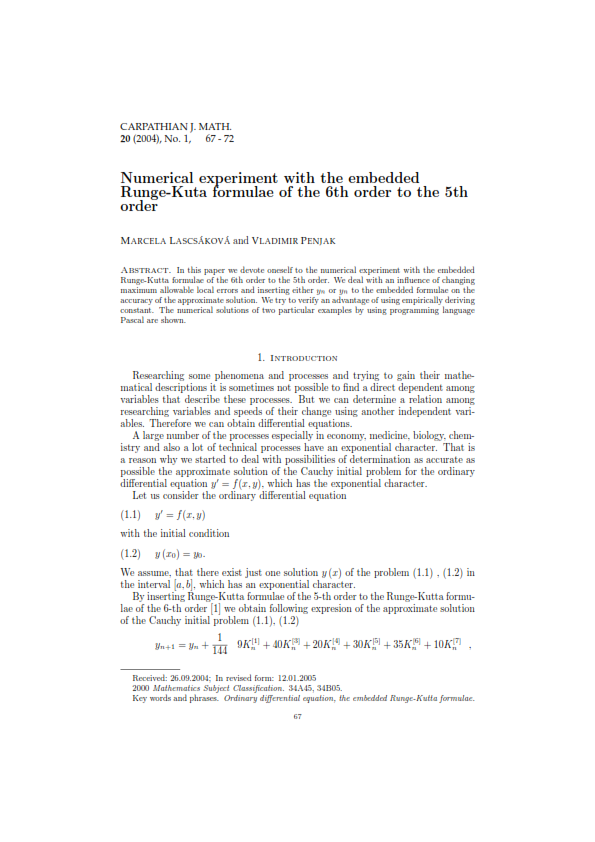
In this paper we devote oneself to the numerical experiment with the embedded Runge-Kutta formulae of the 6th order to the 5th order. We deal with an influence of changing maximum allowable local errors and inserting either yn or yn to the embedded formulae on the accuracy of the approximate solution. We try to verify an advantage of using empirically deriving constant. The numerical solutions of two particular examples by using programming language Pascal are shown.
| Author(s) | Lascsakova, Marcela, Penjak, Vladimir |
|---|
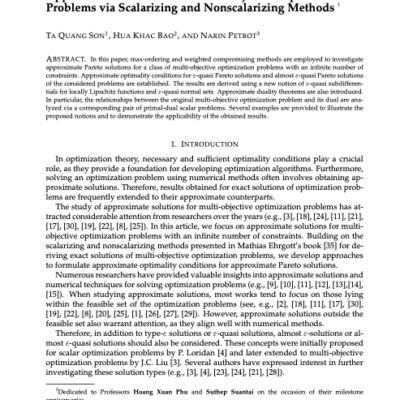 Approximate Solutions for Multi-Objective Optimization Problems via Scalarizing and Nonscalarizing Methods
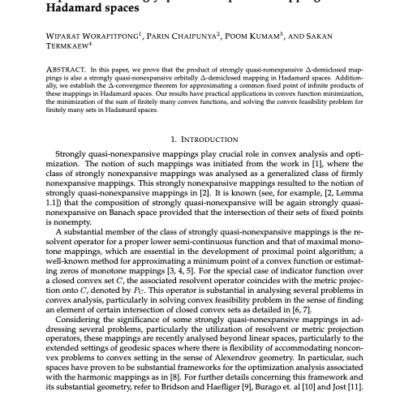 A product of strongly quasi-nonexpansive mappings in Hadamard spaces
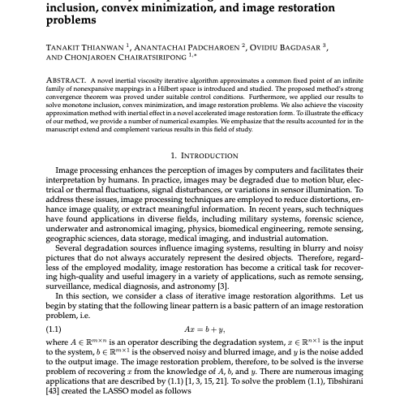 Inertial viscosity fixed point algorithms for monotone inclusion, convex minimization, and image restoration problems
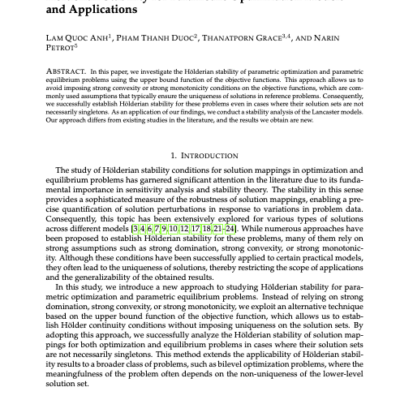 Holderian Stability for Parametric Optimization Models and Applications
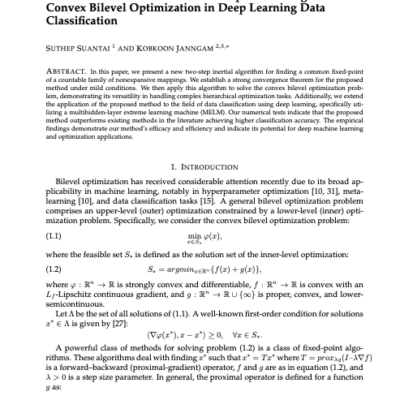 A Novel Fixed-Point Based Two-Step Inertial Algorithm for Convex Bilevel Optimization in Deep Learning Data Classification
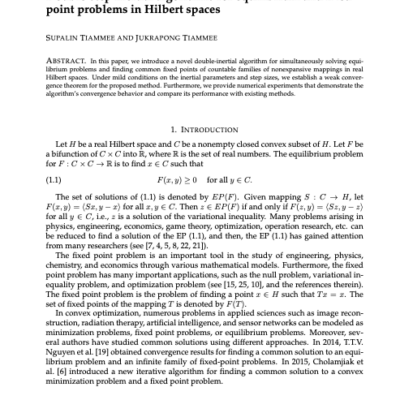 Double-step inertial algorithms for equilibrium and fixed point problems in Hilbert spaces
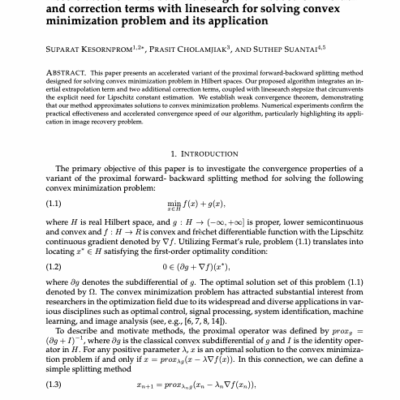 Accelerated forward-backward algorithm based on inertial and correction terms with linesearch for solving convex minimization problem and its application
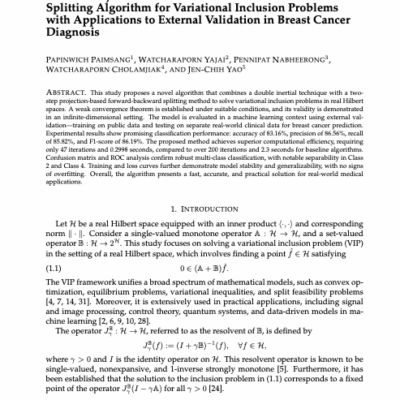 A Dual-Projective Double Inertial Forward-Backward Splitting Algorithm for Variational Inclusion Problems with Applications to External Validation in Breast Cancer Diagnosis
 Efficient Large-Scale Classification with Linex Least Square Twin Bounded Support Vector Machine
 Classifying compressive strength of clay bricks using an inertial projected forward-backward algorithm